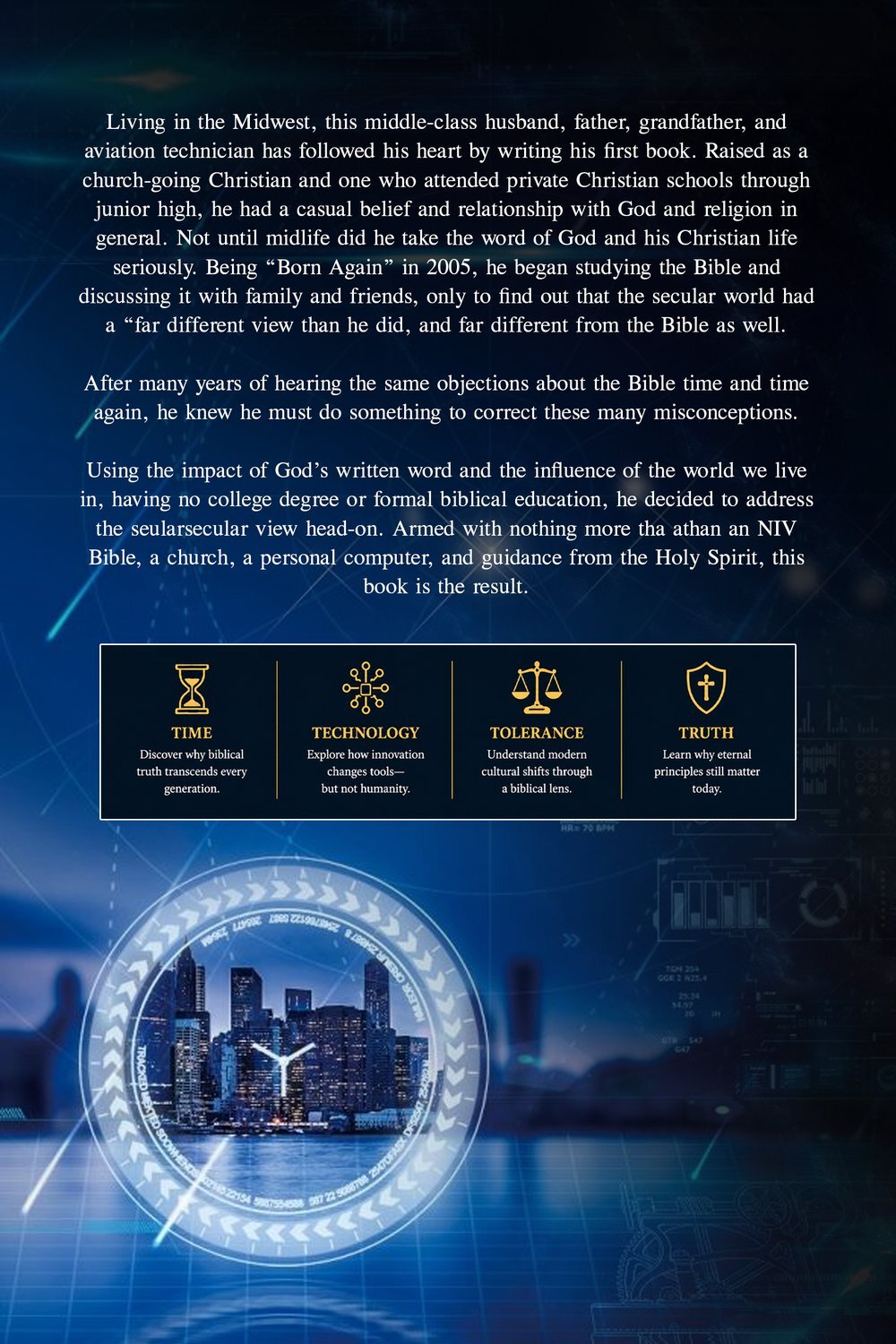

J. Edward is a middle-class husband, father, and grandfather living in the Midwest, where he works as an aviation technician. Raised in a church-going Christian home and educated in private Christian schools through junior high, he carried a familiar, casual faith for most of his life — believing in God without ever seriously studying the book that claims to reveal Him.
That changed in midlife. Being “born again” in 2005, J. Edward began studying the Bible in earnest and talking about it with family and friends — only to discover how far the secular world’s view of Scripture had drifted from his own, and from the Bible itself. After years of hearing the same objections raised again and again, he became convinced that someone needed to answer them plainly.
He has no college degree and no formal biblical education. What he had was an NIV Bible, a church, a personal computer, and — as he’ll tell you himself — the guidance of the Holy Spirit. Time, Technology, Tolerance, and Truth is the result: his first book, written not as a scholar, but as an ordinary believer who decided the secular case against the Bible deserved a direct, honest answer.
— J. Edward, from the Preface
Why does the Bible still matter in an age of jet engines and algorithms? In Time, Technology, Tolerance, and Truth, first-time author J. Edward takes on that question with the plainspoken confidence of a man who has heard every objection at the dinner table and decided to answer them one by one.
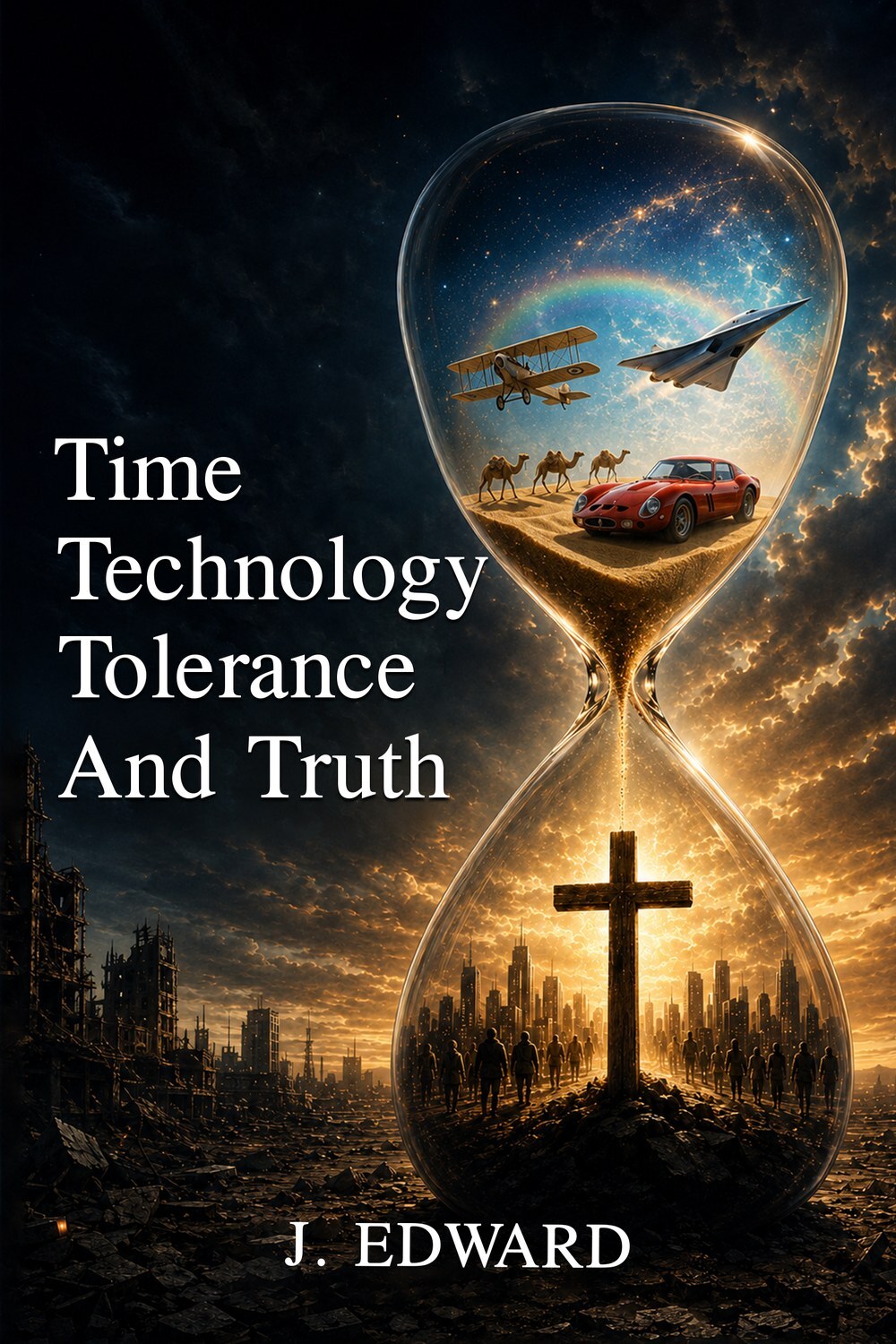
Tracing the history of commerce, transportation, and communication — from the barter system to the credit card, the caravan to the supersonic jet — J. Edward makes a simple but forceful case: technology has transformed almost everything about how we live, but it has never once changed who we are. Sin, selfishness, and the hunger for truth are exactly what they were three thousand years ago — and so is God’s answer to them.
Along the way, the book confronts the excuses used to dismiss Scripture, weighs the Bible’s manuscript evidence against other ancient texts, questions the assumptions behind evolution, and challenges modern “tolerance” as a stand-in for truth — before closing with the one decision J. Edward believes every reader must eventually make.
Christian Nonfiction / Apologetics
100+ Pages
Kindle, Paperback & Hardcover
“In today’s society, there are many popular beliefs, philosophies, traditions, or topics of interest, most of which are easy subjects to discuss among a diverse variety of people. There are a few topics, however — one in particular — that can be uncomfortable to say the least, and dangerous at most, to bring up for discussion in everyday conversation. That subject is the Bible! If you start talking about or quoting from the Bible among the general population, you had better be well prepared to defend it.”
“Of those who will face off with you, you’re going to hear objections such as the Bible is a myth, that it was written by man, it’s inaccurate, has been translated so many times that it can’t be trusted — and, my favorite, that it’s out of touch with the times we live in.”

No seminary degree, no theological jargon — just an aviation technician who studied hard and writes in a voice anyone can follow.

Tackles the excuses skeptics repeat most often — “the Bible is outdated,” “it’s just stories,” “science disproved it” — one at a time.

Compares the Bible’s manuscript record against other trusted ancient texts, side by side.

A candid look at how modern tolerance and political correctness collide with timeless biblical truth.

Draws on everyday life — family, work, technology, even a grandson’s preschool — instead of abstract theory.

Every chapter builds toward the one choice that matters most: what you do with the truth once you’ve found it.

Why seeking the truth — real truth — takes courage before it takes evidence, and what it costs to admit you might be wrong.
A sweeping tour through commerce, transportation, and communication, showing that technology changes constantly — but human nature never has.
How selfishness, sin, and “modern thinking” became the new moral authority — and what got left behind in the process.
The evidence: manuscript reliability, biblical wisdom, and a hard look at the assumptions behind evolution.
Why the only question that matters at the end of life is whether the Bible is true — and why refusing to decide is a decision of its own.
A clear, practical close — and a direct call to study, decide, and act, bravely.
— Introduction
— Chapter 6: Summation
— Chapter 2: Time vs. Technology
— Chapter 1: Bravery
— Chapter 6: Summation
— Chapter 5: Choices

— Reader

— Reader

Reader

Reader

Reader

Reader

Reader

Reader

Reader

Reader

Reader

Reader

Reader

Reader

Reader

Christian - Book store manager
For most of his life, J. Edward’s faith was quiet and familiar — the kind you inherit growing up in church, without ever putting it to the test. That changed in 2005, when he was “born again” in midlife and, for the first time, began studying the Bible seriously instead of simply believing it from a distance.
What he found waiting for him wasn’t curiosity — it was resistance. Conversations with family, friends, and the wider secular world revealed a view of Scripture that was, in his words, “far different” from his own, and far different from the Bible itself. The same objections came up again and again: outdated, unreliable, a myth, a book overtaken by science and time.
After years of hearing those same arguments repeated, J. Edward decided someone needed to answer them directly — not with a theology degree, but with the tools he actually had: an NIV Bible, his church, a personal computer, and prayer. Time, Technology, Tolerance, and Truth is that answer.
A church-going childhood and private Christian schooling through junior high — and a casual faith that followed into adulthood.
A midlife turning point sparks serious study of the Bible — and years of hard conversations with a skeptical secular world.
With no formal training — just Scripture, prayer, and persistence — J. Edward writes the answer he wished someone had handed him.